
An Undergraduate Researcher’s Starter Kit: Math, Notes, and Mindset
By: Liz Zhang
Hello, Carolina Scientific Readers!
Breaking into research is one of the most exciting – and humbling – steps you can take as an undergraduate. It is a continuous process of learning, making mistakes, and asking better questions. In this blog, I interview Dr. Janay Hunt, Assistant Director of UNC’s Office for Undergraduate Research on mindsets that she believes sets apart successful undergraduate researchers. I also share some tangible tips in lab math and documentation that you may find helpful for a smoother transition.
As a side note, I truly cannot believe the academic year is ending. I wish you all a restful and learning-filled summer!
A Conversation with Dr. Janay Hunt
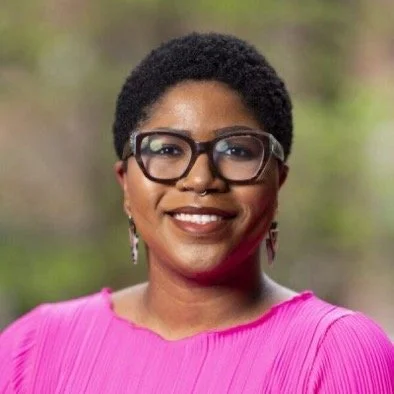
Dr. Janay Hunt
In early February, I had the opportunity to interview Dr. Janay Hunt, Assistant Director of UNC’s Office for Undergraduate Research, about what truly sets undergraduate researchers apart. Dr. Hunt received her B.S. in Biology from NC A&T University in 2017 and completed her Ph.D. at UNC in 2018 with thesis research focused on the effects of chronic cocaine exposure. She now works closely with students across all disciplines who are entering research.
Critical Analysis – Not Just Acceptance
When asked what overlooked skill would most benefit prospective undergraduate researchers, Dr. Hunt didn’t hesitate: critical analysis.
💡“In my experience as a graduate student working in many labs with undergraduates, I could tell when a student was holding back a question. It’s understandable to think you don’t have the knowledge to question the experts, but I would challenge them to ask anyways and learn from the response!”
Dr. Hunt encourages students to approach the scientific literature with skepticism: Why was this method chosen over an alternative? Could a different reagent or dissection technique yield better results? These are the questions that continues science moving forward.
Breaking Down Imposter Syndrome
Dr. Hunt also addressed a challenge that almost all young researchers face imposter syndrome – the persistent feeling that you are not qualified to be where you are.
💡 “This is a feeling I’ve dealt with at every stage of my scientific career.”
Her perspective is realistic: this feeling does not go away. It surfaces at every new stage in a researcher’s journey. After arriving at UNC and exploring addiction neuroscience, Dr. Hunt felt behind due to limited neuroscience coursework as an undergraduate – she used this as motivation to learn more effectively and seek out mentors.
Researchers who learn to act even in the face of self-doubt will thrive in comparison to those that allow it to hold them back. Asking pointed, curious questions about the research, the lab’s direction, and the reasoning behind decisions shows genuine interest – not weakness.
Tangible Curiosity
When asked what quality sets certain undergraduate researchers apart, Dr. Hunt named what she called visible curiosity – curiosity through action.
💡 “I often noticed when an undergraduate was enthusiastic about the science. Even when I was doing a routine action such as data cleaning, they would ask questions and have excitement about where the research was going.”
Authentic interest shows dedication to science that does not go unnoticed. PIs and lab members can tell when someone is simply there to check a box off – and may be less willing to offer advanced opportunities.
Do your Homework
Dr. Hunt’s parting advice is simple: do your homework. Much of what you see in the lab will be new, which is to be expected. Taking the initiative to research methods, reagents, and processes on your own time speeds of your growth. You will become more informed not only about the work being done in the lab but also in the field that you are working in.
🌳 Getting research is a process. Building your skills, documentation, and cultivating an open mindset to learn and grow will take you far beyond your first semester in a lab.
🌎 Here are some bonus skills I thought might be useful to share. Basic Lab Math is used daily, and mastery of certain calculations can greatly improve efficiency. Documentation may seem like a hassle, but when referencing past protocols or finding results, they become extremely necessary.
Lab Math
No matter what type of lab you join, measurements and calculations are a constant part of your daily toolkit. Easily accessing a set of core quantitative skills makes you faster, more accurate, and confident from the start.
Unit Conversions are frequently called upon. For example, many microbiology labs with very small quantities – on the milli-, micro-, and nanoscale. Knowing how to convert between units (e.g. 105 mg = 0.105g, or 0.05L = 50 mL) prevents costly errors when weight or pipetting materials. Dimensional analysis – a favorite from general chemistry – is going to be your best friend.
Concentration and dilution are essential. Research labs routinely prepare, dilute, and standardize reagents, and you will be expected to do so early on. For example, if you need to make 48 mL of a 4% paraformaldehyde (PFA) solution from a 16% stock, can you quickly calculate how much stock and dilutant to use? (Answer: 12 mL stock + 36 mL dilutant using C1V1 = C2V2). Similarly, if you’re seeding cells, and need to reach a specific cell density, knowing how to calculate the right ratio of concentrated cell suspension to growth medium is necessary for the experiment’s accuracy.
💡 Tip: Some labs ask applicants to complete a short math pre-test during the application process. Brushing up on these skills before applying can give you an advantage!
Documentation
Starting in a lab can feel overwhelming. You’re absorbing new information from every direction – equipment locations, reagent preparation procedures, spreadsheet structures, protocols, individual projects of every lab member, and the overall progress of the PI’s objectives. Through well-organized notetaking, you will be able to convert this mass of information into an archive of accessible knowledge to refer to.
The specific system you use matters less than having a system – one that is efficient for you to find the information you need quickly. One effective format, described biochemist Dr. Brianna bible (Be Notable - Lab Notes and Organization), structures each lab day around: a one-sentence summary, goals of the protocol, samples and reagents used (with calculations), and any errors or unexpected results. Dr. Bibel recommends writing mistakes in red, so they are easy to locate in the future. Mistakes noted in this way can be referenced and corrected rather than forgotten until the same one is made.
📷 Below is an image of how Dr. Bibel lays out her physical notes before converting them into an online form:
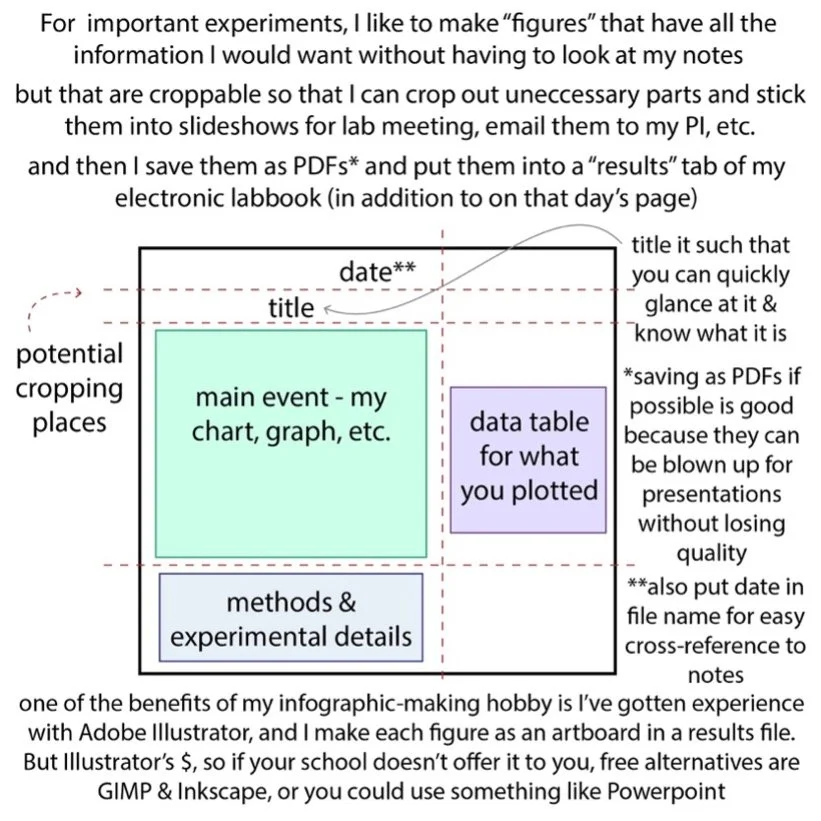
Especially when finding your footing in a new lab, it is important to document observations, and procedures while they’re happening. This allows you to ask questions both during the shadowing and afterwards without losing crucial information. In some cases, it can be helpful to have a digital archive of your lab progress as well as it is easily searchable and can be emailed to various members of the lab/PI for clarification.
Good notes are not just for organization – they are part of the scientific process. Research builds on itself. When your PI asks you to run a protocol independently for the first time, being able to flip back to your observation notes will make that moment far less stressful. Over time, your lab notebook becomes an immediate reflection of the growth you’ve made!
References:
Interview with Dr. Janay Hunt, Ph.D. 02/09/26
“Be Notable! Lab Notes and Organization.” The Bumbling Biochemist, WordPress, 10 Sept. 2021, thebumblingbiochemist.com/365-days-of-science/be-notable-lab-notes-and-organization/. Accessed 2 Mar. 2026.