
From Macroeconomics to the Microscope: A Journey Into Developmental Biology
By: Dhriti Koneru
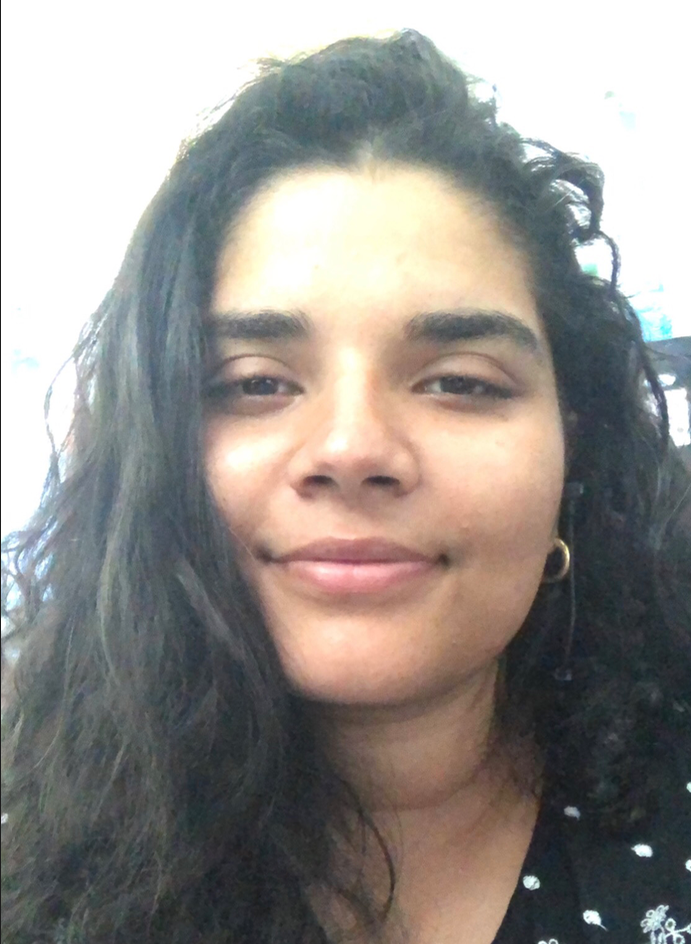
Figure 1. Headshot of Noor Singh
Many of us enter college under the impression that we already know our future aspirations. Some of us want to be doctors, some engineers, and some lawyers. Along the way, there are sure to be moments when you reconsider your goals. There can also be moments that completely shift the trajectory of your career. For Noor Singh this shift happened in an undergraduate classroom.
While pursuing an undergraduate degree at the University of Chicago, Noor had initially set her sights on economics; however, a required class in signaling and immunology sparked her passion for uncovering how organisms develop. She specifically recalls the NF-kB pathway as the mechanism that drew her into the field. 1 She enjoyed learning about the flow of signaling pathways and how various steps in the process could be broken down and further studied. These concepts resonated with Noor and shaped the way she approached problems and asked questions. This eventually inspired her to make the switch into biology and after graduation, led her into the lab of Dr. Vicky Prince, where she initially joined as a research specialist studying developmental biology and was mentored throughout her post-baccalaureate years. Noor then came to the University of North Carolina at Chapel Hill through the Biological & Biomedical Sciences Program before eventually joining the Genetics and Molecular Biology PhD curriculum.
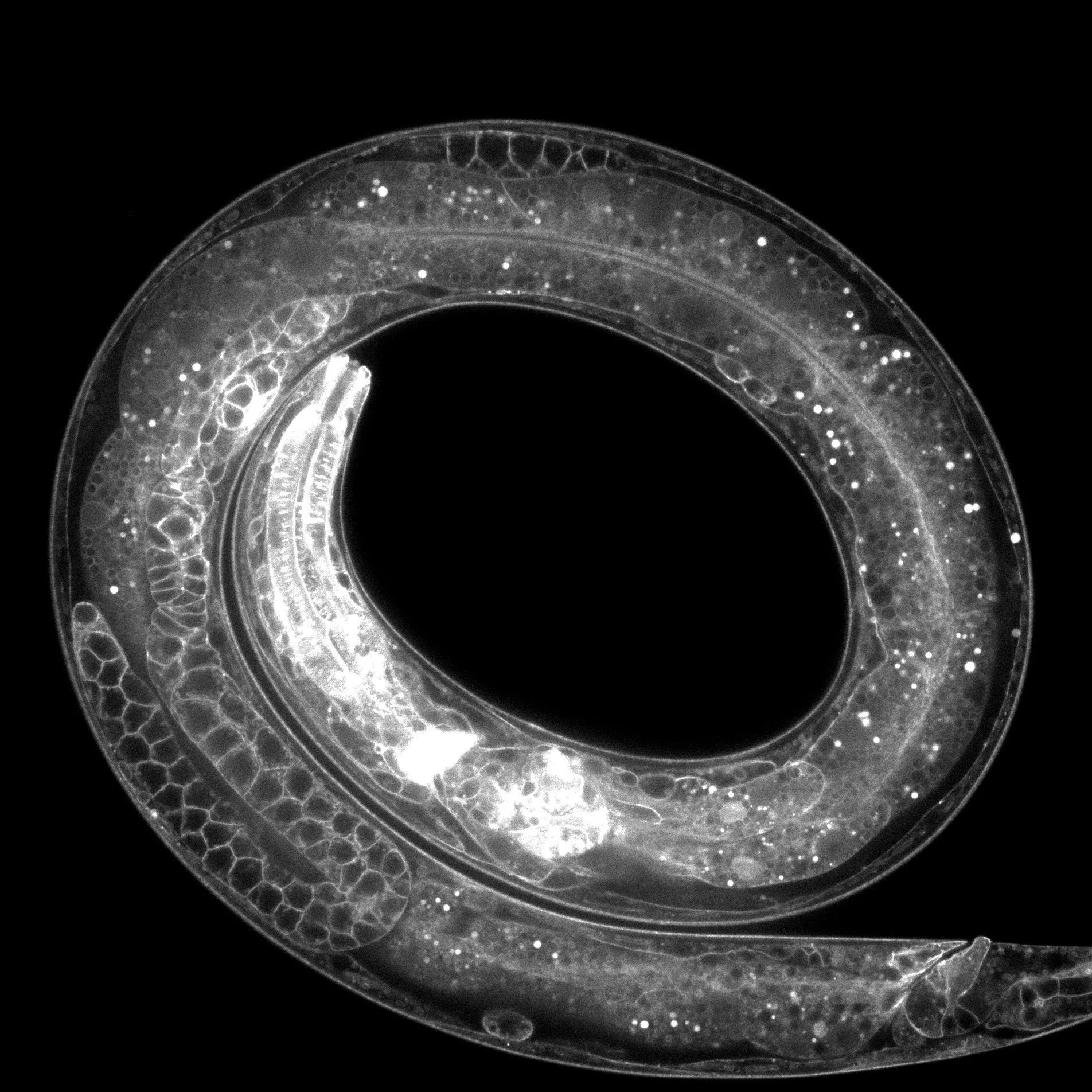
Figure 2. Endogenous RacGTPase expression in a larval C. elegans
Noor is currently a graduate student in the lab of Dr. Kacy Gordon, where she studies morphogenesis, the biological process by which living organisms develop their shape. In organismal development and disease progression, cells must migrate and face different microenvironments where they encounter different forces and pressures. In order to continue migrating, cells utilize a variety of genetic and cell mechanisms, some of which are well studied and others that remain understudied. Noor primarily studies well-characterized genes and pathways and aims to discover novel or non-canonical roles of these specific genes in leader cell migration. 1 She uses C. elegans as a model organism because its simple anatomy and transparency allow for observation of distal tip cell (DTC) migration. Within C. elegans, the gonad is composed of two arms that are developed through DTC migration. 2 By selectively deleting specific genes within a single cell, Noor observes how this migration is impacted and identifies conserved genes required to regulate this movement. 1 An example of this technique in Noor’s work is seen in mutations of a conserved Wnt signaling receptor called Frizzled. When altered, this almost always impacts DTC migration, creating a turning defect (Figure 3). Existing research in worms, mice, and fish has shown that these same genes play analogous roles within vertebrates, making Noor’s work highly relevant to mammalian biology.
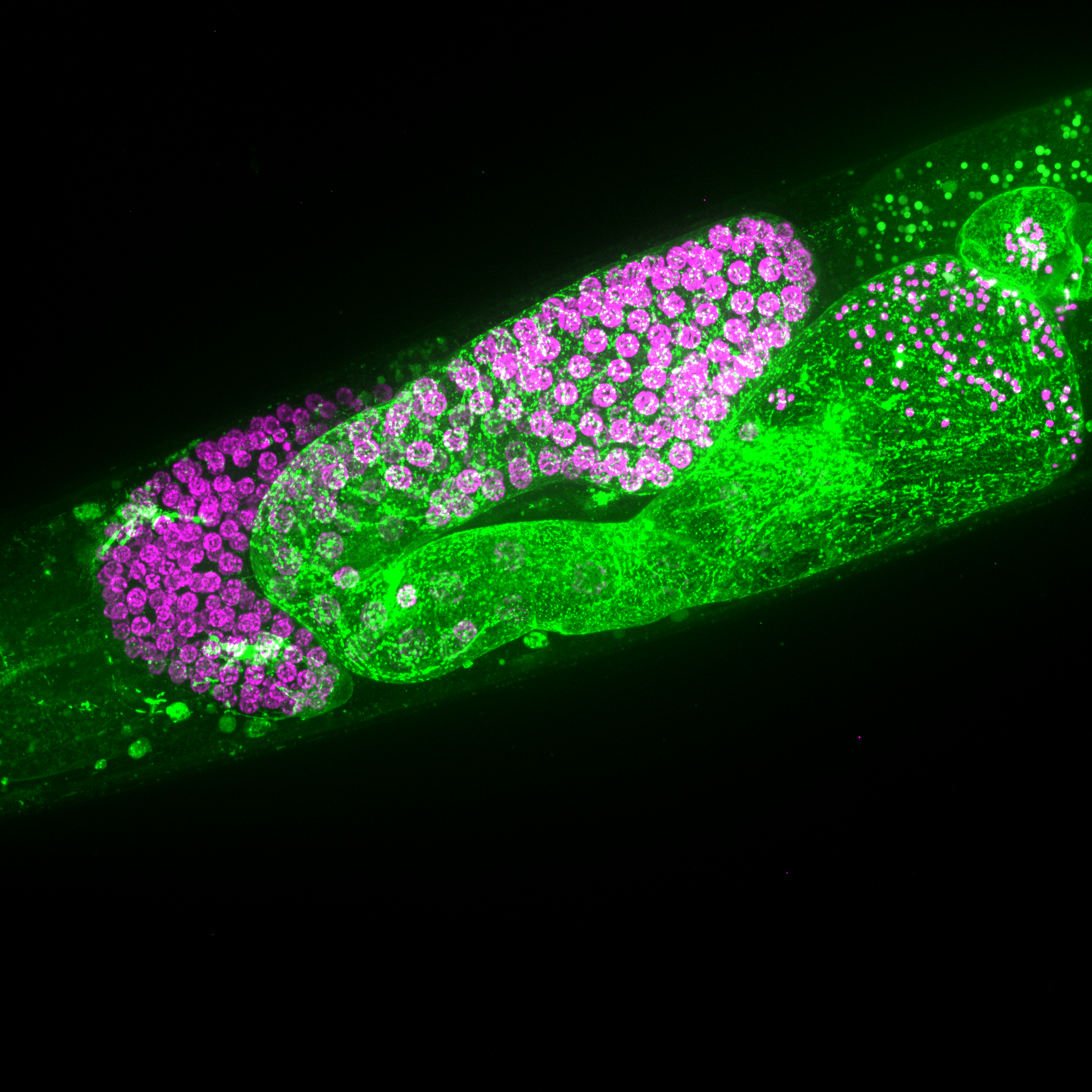
Figure 3. Polarity Reversal Mutation in C. elegans Gonad Arm; pink depicts germ cell nuclei and green depicts an endogenous adhesion marker.
Understanding cell migration is essential to understanding human and animal development. In processes such as morphogenesis, wound repair, and tissue or organ regeneration, cells migrate from their origin across long distances. Additionally, in the development of diseases such as cancer, cancer cells hijack migration mechanisms to spread from the initial tumor site. By identifying which genes and proteins drive this movement, Noor’s work helps highlight potential targets for drug development to prevent cancer metastasis.
Noor will be defending her PhD dissertation this semester and afterwards plans to pursue a postdoctoral position to continue her research. She is dedicated to a career in academia, with the long-term goal of having her own lab exploring related themes and questions.. As for the future direction of her research, she hopes that the next generation of researchers will apply more powerful techniques such as sequencing to map gene expression and high-resolution microscopy to better understand the dynamics of protein expression. Her work leaves a strong foundation for further discoveries in developmental biology and regenerative medicine.
To future researchers who may be in her position, Noor recommends learning how to ask insightful questions early on and immersing themselves in the research community. This could look like participating in seminars, attending research presentations, and reading papers across various disciplines. This exposure will foster critical thinking and the ability to further question what comes next, a skill Noor wishes she had developed earlier in her career. Above all, Noor believes that this kind of broad engagement sparks more meaningful and interesting conversations with others.
References
1) Interview With Noor Singh. 02/20/2026
2) Singh, N.; Zhang, P.; Li, K. J.; Gordon, K. L. The Rac pathway prevents cell fragmentation in a nonprotrusively migrating leader cell during C. elegans gonad organogenesis. Current Biology 2024, 34 (11), 2387–2402.e5.
Double-click to edit...
Double-click to edit...