
The Data Behind a Better Bite
By: Katelyn Nguyen
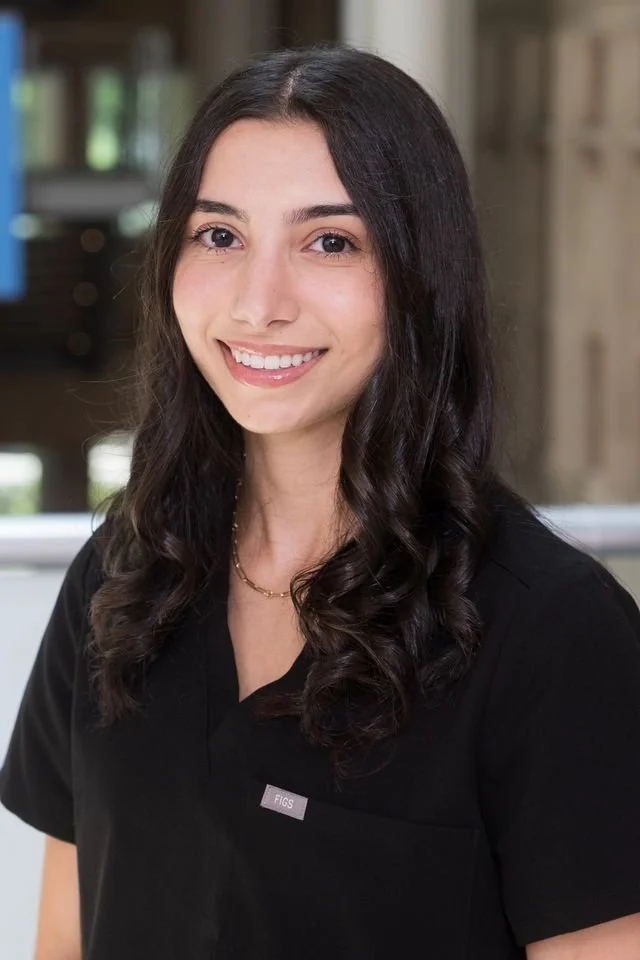
Headshot of Ariana Motamedi
Occlusion, how the upper and lower teeth come together when the jaw functions, remains one of the more complex elements of dental diagnosis and treatment planning. Small differences in how teeth contact one another can influence comfort, function, and the longevity of dental work. Traditional methods, such as articulating paper, help clinicians assess spatial relationships between the maxilla, mandible, and temporomandibular joint, particularly in complex restorative and prosthodontic cases. While these tools help identify where teeth touch, they translate a dynamic process into static markings that require interpretation and experience. Digital dentistry introduces methods that record movement and analyze patterns in ways that extend beyond conventional approaches. Ariana Motamedi, a third-year dental student in the Adams School of Dentistry at the University of North Carolina at Chapel Hill, described her research on digital occlusal analysis and the implications of emerging technologies for clinical workflow and patient communication.¹
Motamedi’s interest in dentistry developed through early exposure to the profession. Her mother is a dentist while her father manages the business side of their practice, providing Motamedi with insight into both the clinical and operational dimensions of care. Over time, this environment shaped her understanding of dentistry as a discipline grounded in technical skill, scientific reasoning, and careful judgment. Alongside her academic work, Motamedi serves as volunteer coordinator at the DYOR clinic, an oral healthcare clinic that provides essential treatment for refugees and underserved individuals. Motamedi recruits student volunteers and supports their service programs.
Her research in digital dentistry began through access to advanced technology in her mother’s practice, where a jaw tracking system described as a digital articulator had been recently introduced. Motamedi’s exposure to this system provided an opportunity for her to observe how digital tools could capture functional relationships that are difficult to evaluate with conventional methods. The digital version records jaw motion and contact patterns, generating data that can be reviewed and compared across multiple recordings. Motamedi’s project examined how this system performs alongside other approaches used to evaluate occlusal contacts, including static intraoral scanning and dynamic force sensors that measure contact timing and distribution.
One motivation for adopting digital occlusal tools involves their ability to enhance patient understanding. Motamedi noted that digital visualizations allow clinicians to display occlusal patterns through color mapping, magnification, and motion playback. These features can clarify explanations of contact relationships and treatment planning considerations. Research in digital occlusion has similarly emphasized that visual feedback supports communication and helps integrate diagnostic information into patient-centered decision making.2 In addition to educational advantages, digital workflows may reduce repeated adjustments and streamline laboratory processes, which can influence efficiency and material use.
The study involved a small research team. Motamedi conducted survey recruitment, scanning procedures, and primary data collection. Dr. Wendy Clark, a professor at UNC ASoD, provided mentorship and oversight, while Dr. Tariq Alsahafi, a PhD student in the Oral Craniofacial and Biomedicine Department, contributed statistical analysis and interpretation. Participants were recruited from among classmates, which enabled data collection while also introducing limits in sample diversity and scale. Motamedi identified these constraints as a common feature of early-stage research and a factor that shapes interpretation and future study design.
The project compared three approaches to occlusal analysis. One method used a dynamic sensor that records force distribution and contact timing during closure. Another relied on a static scan that captures occlusion visually. The digital articulator added a third dimension by relating jaw movement to contact formation across functional pathways. Comparative research on digital occlusal systems has demonstrated that differences in data acquisition, whether static or dynamic, can influence how contacts are detected and interpreted.3 Motamedi’s findings showed consistent contact detection under conditions of stable occlusion, supporting the reliability of the measurements within the defined parameters of the study.
Motamedi explained that “reliability” referred to the consistency of repeated measurements across devices. She defined stable occlusion as the presence of a balanced bite and the absence of structural compromise that could distort contact patterns. Under these conditions, the devices produced comparable contact counts, indicating that the measurements reflected functional relationships rather than variability introduced by the recording process. Reliability remains central to digital occlusal research because clinical decision making depends on confidence in recorded data.
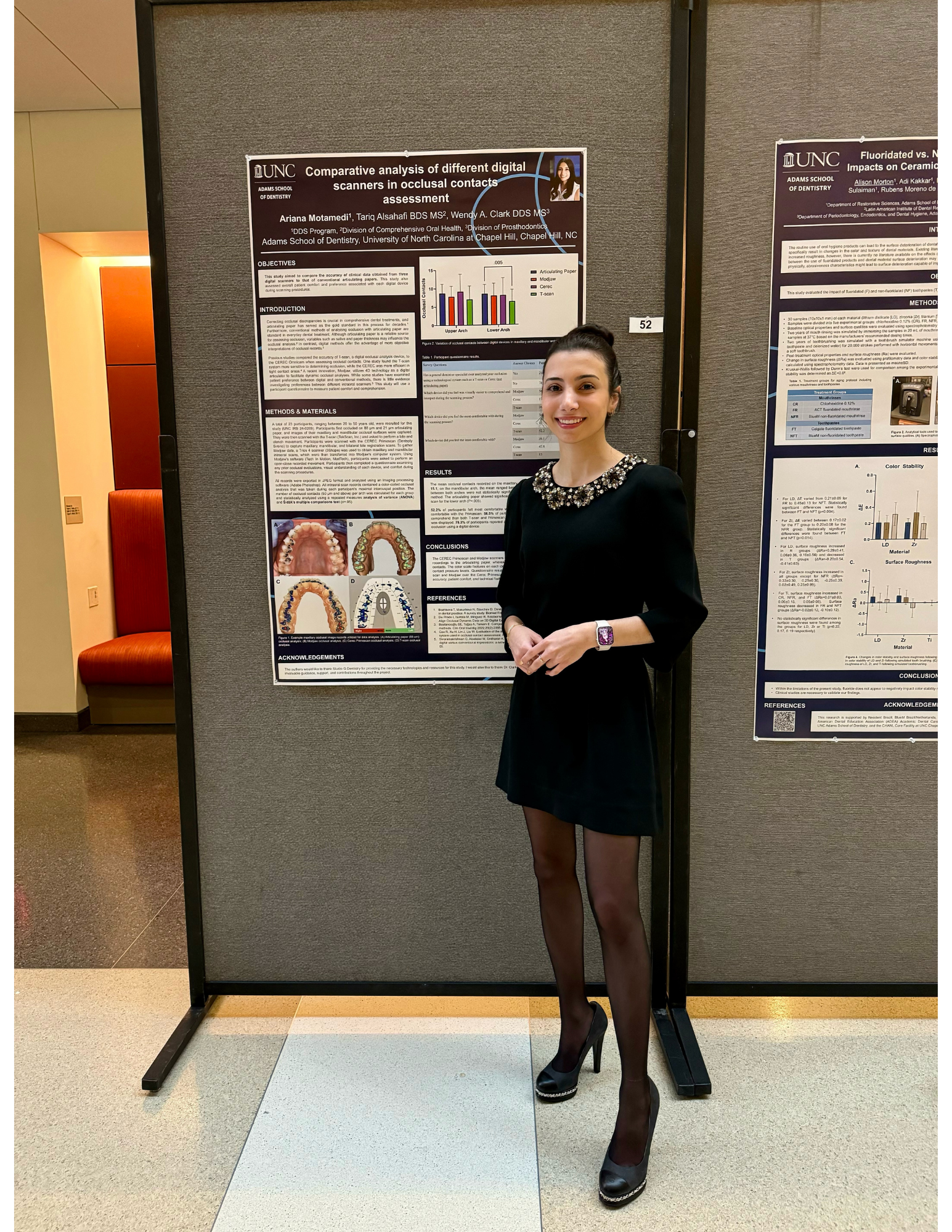
Motamedi Poster Presentation at 2025 UNC ASoD Research Day Event
An unexpected finding involved patient comfort. A scanner widely recognized for accuracy was rated lower in comfort by participants, largely because of its size and intraoral positioning. This observation highlights the role of usability in clinical adoption, particularly when technologies require significant investment and must function across diverse patient populations. Evaluations of digital occlusal systems frequently note that comfort, workflow integration, and learning curve influence whether tools become established in practice.4
Motamedi described several directions for future research that extend beyond the scope of her initial project. Contact location and surface area represent variables with important clinical implications, as force distribution and contact intensity may influence restorative outcomes and functional stability. Timing patterns and dynamic interaction between contacts also warrant investigation, particularly in cases involving equilibration or occlusal adjustment. Uneven or excessive occlusal contacts may contribute to localized trauma, accelerated wear, or discomfort that resembles pulpal pathology, which underscores the importance of tools capable of detecting subtle functional differences.
Motamedi also addressed the potential role of artificial intelligence in digital dentistry; she suggested that AI could assist in scan interpretation and support predictive modeling in treatment planning. Current applications already include radiographic analysis and pattern recognition in diagnostic imaging, and similar approaches may extend to occlusal analysis. At the same time, she emphasized that technological support should complement rather than replace clinical reasoning. Foundational diagnostic skills remain essential for interpreting data and managing uncertainty.
Despite the expansion of digital workflows, Motamedi does not anticipate the disappearance of analog techniques. Certain clinical situations continue to present challenges for digital capture. For this reason, a hybrid approach that integrates both digital and conventional methods will likely remain necessary. Increased access to digital tools may broaden their application, yet adaptability will continue to define clinical practice and education.
Digital occlusal analysis reflects a broader shift toward data-informed care in dentistry, where measurable information supports diagnostic clarity and interdisciplinary collaboration. Motamedi’s work illustrates how emerging technologies contribute to understanding complex functional relationships while also revealing the practical considerations that shape implementation. Continued investigation into accuracy, usability, and clinical relevance will determine how these tools integrate into routine dental practice and education.
References
Interview with Ariana Motamedi, D3, UNC Adams School of Dentistry. 02/24/26
Al-Ani, Z.; Yar, R. Evolution of Dental Occlusion, Integrating Digital Innovations. Primary Dental Journal. 2025, 14 (1), 53–65
Bostancıoğlu, S. E.; Toğay, A.; Tamam, E. Comparison of Two Different Digital Occlusal Analysis Methods. Clinical Oral Investigations. 2022, 26 (2), 2095–2109
Dinçer, G.; Chamma-Wedemann, C. N.; Ribeiro Dos Reis, I. N.; da Silva, E. V. F.; Çakmak, G.; Yılmaz, B.; Sesma, N. Comparison of Digital Technologies for Occlusal Analysis in Dentate Arches, A Systematic Review. Journal of Dentistry. 2025, 163, 106114