
Teaching to Learn, Learning to Teach: How Dr. Eric Hastie is Reframing Biology at UNC
By: Sofia Salazar
For many students at UNC - Chapel Hill, taking Biology 101 is a rite of passage; it may mark a student’s first step towards medical school, or it may be the last science class they ever take. Dr. Eric Hastie is well-acquainted with both perspectives. As a Teaching Assistant Professor in UNC’s Department of Biology and Co-Director of the Carolina Biology Education Research Lab (CBER), he teaches some of the university’s largest introductory courses. In a department with roughly 2,800 majors, his work hinges on understanding how introductory science courses can foster deep learning over memorization.
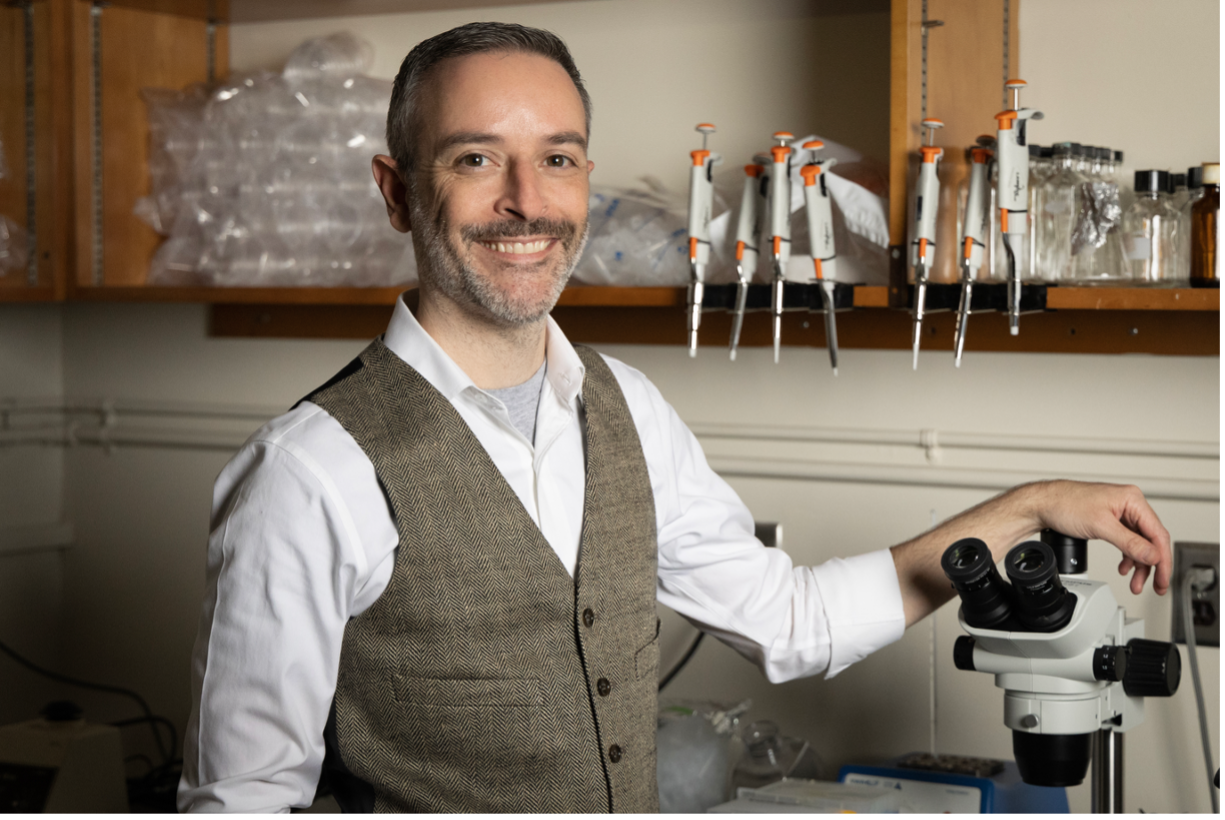
Headshot of Dr. Eric Hastie
In the CBER Lab, Dr. Hastie studies how students best learn biology, and how that learning can be improved. In a society where perfectionism is prevalent and grades can feel all-consuming, CBER seeks to redefine how students engage with science in the classroom, creating a more rewarding educational experience that prioritizes curiosity over competition.
Dr. Hastie’s approach to education research is rooted in his own unconventional career path, defined by his own persistent curiosity. He graduated from the University of Florida with a B.S. in journalism before pivoting to earn a Culinary Arts degree at the Institute of Culinary Education. After working for two magazine companies, he returned to academia to complete his Ph.D. in Molecular Biology at UNC - Charlotte. It was during his postdoctoral fellowship at Duke, while serving as a teaching assistant, that he discovered his interest in teaching: not only delivering biological content, but noticing how students interact with such content.
Once hired as a Teaching Assistant Professor at UNC - Chapel Hill in 2020, he began collaborating with Dr. Laura Ott, a fellow Teaching Assistant Professor of Biology at UNC -Chapel Hill, on student-centered classroom experiments, including the implementation of filming biology-centered TikTok videos to measure content retention in Biology 101 classes. By 2021, this work had evolved into the founding of the CBER Lab.
CBER functions as both a research hub and a collaborative workspace for instructors and students alike. Alongside fellow Co-Director Dr. Ott, Dr. Hastie investigates questions central to undergraduate science learning, such as how classroom environments can encourage students to participate without fear of failure. Their objective is to determine how to assess student learning outcomes and what tools or techniques can be implemented to improve how biology is taught. This assessment is done through the development and implementation of hands-on activities, new modules, the evaluation of the effectiveness of cheat sheets, and more.
To move the needle on biology education in CBER, one must first understand the value of effective communication. As a former journalist, Dr. Hastie is always considering the audience’s perspective. Eliminating jargon, emphasizing clarity, and retaining accuracy is paramount: “You’re going to simplify it in a way that anybody could understand it. That’s not dumbing it down,” he affirms. To achieve this, content relevance is crucial: reassessing and revitalizing biology curricula is what the CBER Lab is all about.
Research questions in the CBER Lab are not hard to come by. Each semester, Dr. Hastie oversees two biology lab courses and teaches one large-lecture course, totaling around 1,000 students, while simultaneously coordinating teaching assistants and peer instructors. “I knew my focus was always going to be towards those 101-level, introductory courses. . . That’s where I feel I have an impact,” he explains. These courses serve as ideal testing grounds for CBER’s research. Because these classes include students with widely different career trajectories, they provide a diverse sample for studying how different groups engage with biology.
Implementing these ideas follows a chronological process: a learning challenge in the classroom is identified, and the CBER team develops an intervention, such as a new lab module or assessment strategy. The module is then implemented in a course setting, and student engagement and feedback are collected. Finally, the team analyzes these outcomes to determine whether the intervention improved student learning. In this way, classroom teaching and education research become tightly interconnected, with each semester generating new data that inform the next iteration of the curriculum.
One example of this can be seen with the revitalized Biology 101 Lab curriculum introduced in the spring semester of 2026. The updated curriculum integrates current events and real-world biological applications into lab activities, providing students with concrete examples of how biological concepts operate beyond the classroom. What’s more, the in-person meeting times have been shortened, meaning Biology 101L is no longer a 3-hour class period. Through CBER, he can track how these contextualized modules influence student engagement and comprehension, especially for non-biology or non-pre-health majors who are required to take the course.
“It’s rewarding to see [non-pre-health students] enjoying biology in a way that makes it relevant to their lives, and [I’m] hoping that it is communicated in a way where they can talk to their communities about science in a positive light,” he reflects.
Collaboration is central to how the CBER Lab operates. Rather than developing curriculum changes in isolation, the lab actively involves undergraduate researchers. In the spring of 2023, Gabriella Santiago and Margaret Furco, both currently undergraduate seniors at UNC-Chapel Hill, developed a curriculum in molecular biological sciences that emphasizes a course-based undergraduate research experience (CURE) with the goal of enhancing student learning via hands-on research. Their curriculum now runs once a year as an in-person course: Biology 223L, known as the Molecular Genetics Research Laboratory. Dr. Hastie takes pride in the way CBER has set the foundation for students like Gabriella and Margaret to have autonomy over curriculum development and hopes he can continue to nurture such growth and experimentation without students’ fear of failure or the pressure of grades.
Looking ahead, Dr. Hastie sees the future of the CBER Lab focusing increasingly on intrinsic motivation: understanding why students choose to engage or disengage from scientific learning remains a central question of his. CBER aims to explore how classroom structures and assessment methods influence that motivation. How biology is communicated and presented may play a role: “I think it is important to connect how students are communicating science to different audiences and how that can help with their own learning of the material,” he explains.
Ultimately, Dr. Hastie hopes students of all backgrounds leave his courses more resourceful and more capable of communicating with respect and positivity.
“I hope they just take this love of biology and spread it everywhere - to the whole world!” Dr. Hastie exclaims.
The work at CBER Lab reflects a broader goal that extends beyond any single course. By reframing biology to be an approachable and accessible field, Dr. Hastie and the CBER Lab are shaping future scientists and nonscientists alike, making science engaging and exciting for all.
References:
Interview with Dr. Eric Hastie, Ph.D. 02/10/26.
LaFaro, A. A Boost for Biology Education. https://endeavors.unc.edu/a-boost-for-biology-education (accessed February 7th, 2026).
Email with Gabriela Santiago. 02/27/26.
Email with Dr. Eric Hastie, Ph.D. 02/13/26.