
Small Molecules, Big Implications: How One Game Led to Cancer-Fighting Chemistry
By: Jane Ripps
On April 4, 2005, the UNC men’s basketball team defeated Illinois’ Fighting Illini in the national championship to claim their fourth NCAA title. The victory marked not only a defining moment for the program, but also the unexpected beginning of a science career.
Headshot of Dr. Lindsey James
While it may seem strange to select a school based on a basketball game, that was the tipping point for Dr. Lindsey James, Associate Professor at the UNC Eshelman School of Pharmacy.
“My senior year of college, UNC was playing against Illinois, and I was deciding between them and a graduate program in Chicago,” she recalls. “I told myself, ‘I'm going to choose based on the game,’ which wasn’t fully true. I knew I wanted to come here, but that's the story I often tell.”
Over 20 years later, Dr. James' career as a Tarheel has emerged to be much like that fateful day: groundbreaking.
Dr. James's passion for chemistry began long before arriving at Chapel Hill. In fact, she credits her high school AP Chemistry teacher for pulling her in. She spent her undergraduate years at Colgate University; and it was here that Dr. James realized that while she was interested in the medical field, she yearned for a more analytical angle.
“I enjoyed my chemistry and math classes a lot more than the biology,” she recalls. “So, I decided to give it a chance.”
Dr. James began applying for doctoral programs in organic chemistry and landed at Carolina — a decision “a bit off the beaten path” for someone who grew up in the Northeast. During her studies, she worked under Distinguished Professor Dr. Marcey Waters at the Department of Chemistry before continuing onto a postdoc with Professor and Director of the Center for Integrative Chemical Biology and Drug Discovery Dr. Spencer Frye. While working with Dr. Frye, she made the major leap from pure chemical research into translational medicinal chemistry.
That experience steered Dr. James towards a career uniting chemistry and pharmaceuticals, eventually culminating in her professorship at Eshelman in 2019. Today, Dr. James’ work involves not only making molecules, but asking questions about their properties.
“How do you screen them? How do you improve them? How do you make them suitable for use not only in a test tube, but maybe in an animal?” she says.
Not only has the Chapel Hill community pleasantly surprised her — turning a five-year endeavor into a forever home — but it has provided an outlet for tenured exploration and mentorship. A steady focus on organic chemistry had progressed into a cellular investigation into epigenetics and the formulation of groundbreaking novel cancer treatments.
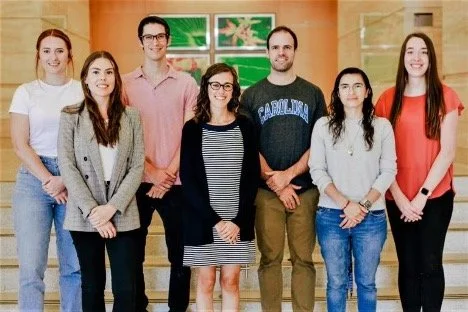
The James Lab team.
Today, Dr. James’ research bridges chemistry and pharmaceutical composition. “In contrast to some of the other labs in my department that are trying to use very sophisticated molecules to make natural products and other complex structures, we're trying to make a lot of molecules as simply as possible,” she explains. Dr. James works alongside her team to test various small-molecule compounds against proteins of interest for binding tendencies, inhibitive effects, and other signs of biological activity. This approach helps the group pinpoint molecules that may affect biological systems, highlighting them as worthy of further tweaking and experimentation. Lately, Dr. James has been using it to learn more about the behavior of cancer cells.
“By running these cells through our molecular assays, we want to understand the functional effects the molecules may, for example, have on the cells’ growth,” she says.
In contrast to larger pharmaceutical companies, compounds in the James Lab are understudied targets and are mainly used to elucidate the role of proteins in disease. “We try to think about making compounds that can be used as tools by the biomedical community to better understand how these proteins affect disease in a fundamental way,” Dr. James shares.
One of the lab’s current projects focuses on methylation reader proteins. In the cell, DNA is wrapped around proteins called histones. Attached to them are individual amino acids — targets for chemical tags such as methyl groups. Reader proteins can then bind to these groups, allowing them to regulate gene expression or carry out their own enzymatic activity. The James Lab wants to know what happens when the reader proteins fail. “Sometimes, we get genes that should be on but get turned off, and vice versa. Overexpression, mutation, and translocation to other proteins can all lead to this; and there’s a lot of work being done on the readers to understand what role they play,” Dr. James explains. Earlier research has tried fully removing the readers by knocking them out of the genetic code, but Dr. James’ wants to know whether inhibiting the reader protein’s binding could have a similar effect. One reader family of interest is the NSD2 inhibitors, which have been implicated in diseases such as multiple myeloma, prostate cancer, and pancreatic cancer. In collaboration with various labs around the country and world, Dr. James has been making small molecules that bind to NSD2 and act as markers for ubiquitylation, nudging the cell to degrade the specific protein.
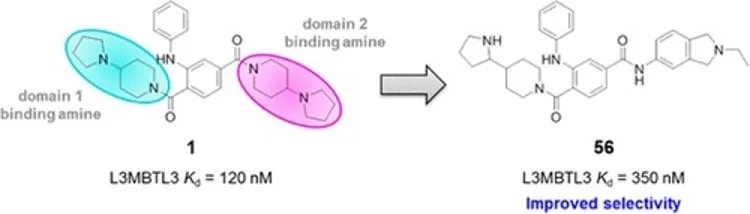
The James Lab modifies small molecules to optimize their interactions with target proteins.
The goal is to uncover novel ways to remove such harmful proteins from the cell. “We've made a lot of molecules and tested them on a lot of different systems,” Dr. James reflects. “We're now trying to get them into mice to see how they fare in different models of cancer. Doing something in a cell is wildly different from doing something in an animal, and that's a big barrier we often run into.”
While there is still progress to be made, Dr. James’ focus on reader proteins is a powerful step forward for the development of therapeutic drugs and treatments — and these discoveries haven’t gone unnoticed. In 2025, she was awarded the Hettleman Prize for Artistic and Scholarly Achievement — one of UNC’s most prestigious honors — for her work in synthesizing molecules that target and degrade proteins responsible for diseases that previously lacked treatment.
As she continues her career at Eshelman, Dr. James hopes to foster the same collaborative culture that kickstarted her own doctoral journey — from the unforgettable people, to the small molecules she is helping bring to life.
References:
1. Interview with Linsey James, Ph.D. 3/3/26.
2. Hanley, R. P.; Nie, D. Y.; Tabor, J. R.; Li, F.; Sobh, A.; Xu, C.; Barker, N. K.; Dilworth, D.; Hajian, T.; Gibson, E.; et al. [Paper title right here in normal font. Delete my brackets and add a period at the end.] J. Am. Chem. Soc.2023, 145, 8398–8411.